
Most ecommerce brands spend the majority of their marketing budget getting a stranger to buy once. Very few spend the same energy figuring out how to make that person buy a second time, a third time, a tenth time. That gap — between what brands spend acquiring customers and what they invest in keeping them — is where most of the untapped revenue in ecommerce actually lives.
This guide covers everything you need to understand ecommerce retention properly: what it actually means, why the economics favour it so heavily, how to measure it, where most brands go wrong, and a practical 90-day roadmap for building a real retention system — whether you're starting from scratch or trying to fix something that isn't working.
If you'd rather work through this offline, we also built a downloadable Ecommerce Retention Playbook PDF with worksheets, a KPI tracker, and a full retention audit checklist you can print and fill in.
What Is Ecommerce Retention?
Ecommerce retention is the set of strategies and systems a brand uses to keep customers buying after their first purchase. It covers everything that happens after checkout: the emails and texts a customer receives, the experience of using the product, how the brand responds when something goes wrong, and how it earns a second, third, and tenth order.
It's easy to confuse retention with "email marketing" or "loyalty programs," but those are just two channels retention runs through — not the whole discipline. Retention is bigger than any single tactic. It's the answer to one question, asked continuously: why would this customer buy from us again instead of going somewhere else?
Acquisition is everything that happens before someone becomes a customer — ads, SEO, influencer partnerships, the first-visit conversion rate on your site. Retention is everything that happens after — onboarding, post-purchase flows, loyalty, win-back, customer experience.
- Repeat purchase rate — the percentage of customers who buy more than once
- Customer lifetime value (CLV) — the total revenue a customer generates over the full relationship
- Retention rate — the percentage of customers still active over a given period, the inverse of churn
- Time between purchases — how quickly customers come back, and whether that's speeding up or slowing down
$40 acquisition cost recovered from a single $50 first order.
Same $40 acquisition cost, four $50 orders across the year.
None of this replaces acquisition — you obviously still need new customers coming in. But most brands treat acquisition as the whole growth strategy and retention as an afterthought, when the healthiest businesses treat them as two engines running at the same time.
The RetainLabs Retention Growth Loop™
Most retention advice treats acquisition and retention as separate conversations. We don't. We map every client's growth against a single continuous loop — not a funnel that ends at checkout, but a cycle that feeds itself.
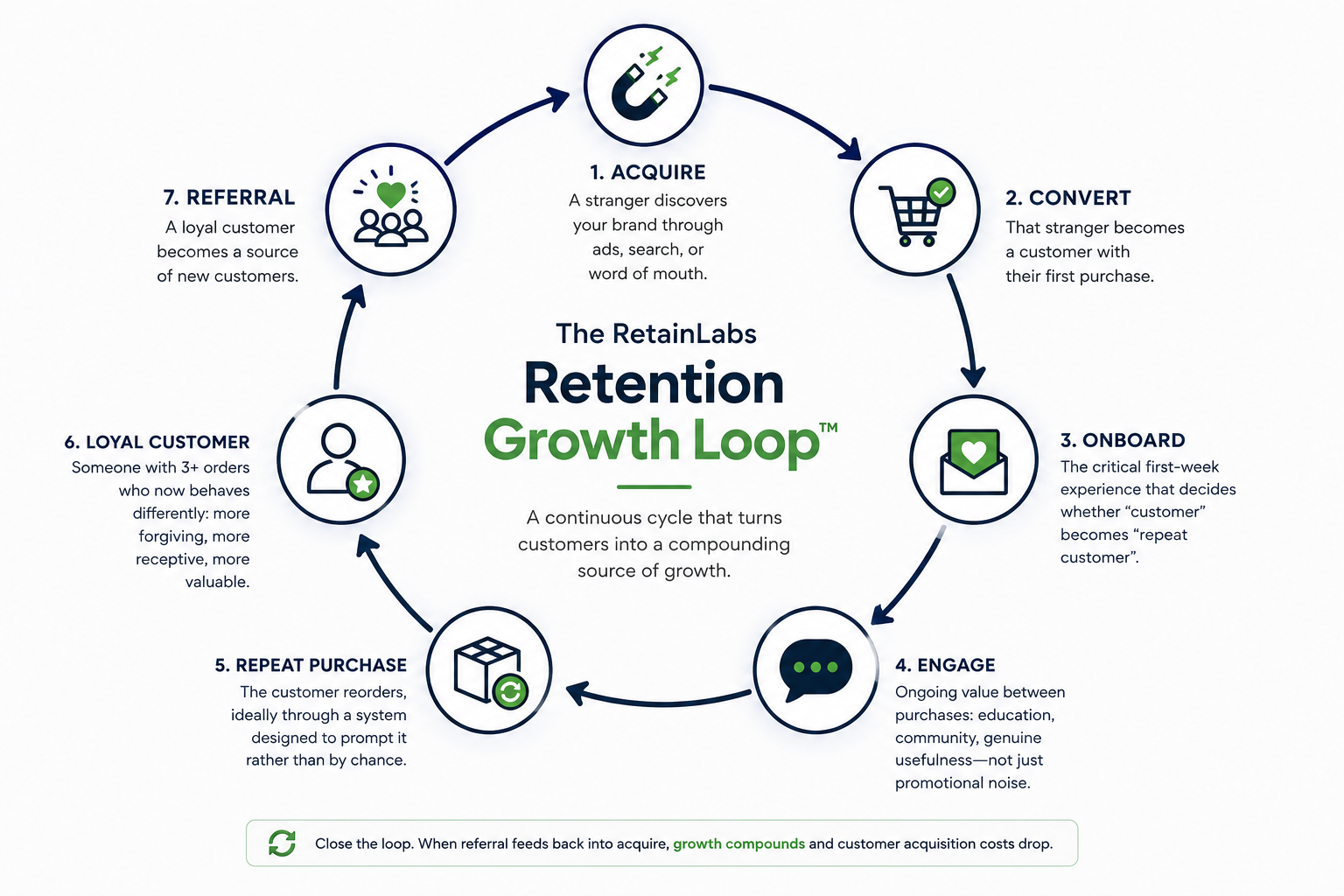
A stranger becomes aware of your brand.
That stranger becomes a customer with a first purchase.
The first-week experience that decides everything after it.
Ongoing value between purchases, not promotional noise.
The reorder, prompted by design rather than by chance.
3+ orders — more forgiving, more valuable per interaction.
A loyal customer becomes a source of new customers.
The loop closes and compounds.
Most brands pour their resources into the first two stages and quietly let the loop break somewhere around Onboard or Engage. When that happens, every new customer has to be acquired from scratch, forever, because nothing feeds Referral back into Acquire. You can see how we apply this loop step by step on our process page.
Why Retention Matters More Than Acquisition
Every ecommerce brand eventually runs into the same wall: acquisition costs keep climbing. Retention doesn't have that problem in the same way — the customer already exists, already trusts you enough to have bought once, and is measurably cheaper to sell to again.
- Acquiring a new customer typically costs 5 to 25 times more than retaining an existing one (Harvard Business Review).
- A 5% improvement in retention can increase profits by 25% to 95% — originating from Frederick Reichheld's work at Bain & Company.
- Existing customers convert at roughly 60–70% when asked to buy again, compared to 5–20% for a brand-new prospect.
The compounding effect
Retention doesn't just save money — it compounds. A customer who buys a second time is statistically more likely to buy a third time than a first-time buyer is to buy a second. Think of it as a flywheel rather than a funnel: each retained customer makes the next retention effort a little easier. Acquisition-only growth has no equivalent momentum — every month starts back at zero.
Why brands still under-invest in it
- Acquisition results are visible immediately. Retention's payoff shows up over months.
- Retention requires infrastructure, not just spend. You can't "boost" it the way you boost an ad.
- Nobody's forced to look at it. Repeat purchase rate and CLV usually require someone to go looking.
- It's genuinely less exciting to talk about — even when it's worth more money over a year.
That last point is the real opportunity. You can see what that edge looks like in practice on our case studies page, including one brand that unlocked $980,000 in previously untapped revenue from a single retention audit.
Customer Lifetime Value
Customer Lifetime Value (CLV) is the total revenue a single customer generates over the entire time they buy from you. It's the single most important number in retention, because it reframes every customer from "one transaction" into an ongoing relationship with a dollar value attached.
CLV = Average Order Value × Purchase Frequency × Customer Lifespan
Example: a skincare brand with a $55 average order value, where the average customer orders 3 times a year and stays active for 2 years, has a CLV of $55 × 3 × 2 = $330.
Why most brands get CLV wrong
- They calculate it once and never again — CLV should be tracked quarterly.
- They use it as a vanity number instead of a decision tool.
- They ignore CLV by segment, which hides where the real opportunity is.
A brand with a blended CLV of $220 might actually have a $90 CLV for one-time discount shoppers, $260 for email subscribers, and $540 for anyone in a subscription or loyalty tier. Treating all three as "$220 customers" means over-investing in the weakest segment.
Customer Lifetime Value
- Calculate your blended CLV using the formula above
- Break CLV out by at least 3 customer segments (first-time, subscribers, VIP)
- Compare CLV to your current acquisition cost per channel
- Set a recurring quarterly reminder to recalculate
- Flag which segment has the highest CLV and note what makes them different
Want to see where your own store lands? Our free Ecommerce Revenue Calculator uses a simplified version of this exact formula.
Repeat Purchase Rate
Repeat Purchase Rate (RPR) is the percentage of your customers who have bought more than once — the fastest health check on whether your growth loop is closing rather than leaking customers after the first order.
RPR = (Customers With 2+ Orders ÷ Total Customers) × 100
Example: 1,000 unique customers over the past year and 280 second orders gives you a repeat purchase rate of 28%.
- A strong post-purchase flow. The period right after a first order decides whether there's a second.
- Timing the ask correctly — based on your product's actual repurchase cycle, not a generic 30-day default.
- Segmentation. A one-time buyer and a three-time buyer shouldn't get the same win-back email.
- Removing friction from reordering — saved payment details, one-click reorder, subscriptions.
- Product experience, not just marketing. No sequence fixes a product that didn't meet expectations.
If your repeat purchase rate has been flat for months despite new customers, the issue usually isn't acquisition. That's exactly what our lifecycle marketing and retention strategy services are built to fix.
The Ecommerce Customer Journey
Retention strategy only works when it's mapped against where the customer actually is in the loop. Sending the same newsletter to a brand-new customer and someone who's ordered eight times treats a very different relationship as if it were identical.
This window sets the tone for everything after it. A strong shipping-update sequence, accurate delivery times, and an unboxing experience that matches what was promised matter more than any discount code.
Make sure the customer actually gets value: how-to content, usage tips, a genuine check-in rather than an immediate upsell. The highest-leverage moment to invite a review.
Specific to your product's natural cycle — 30 days for a consumable, 90 for seasonal apparel, a year for something durable. Getting this wrong is one of the most fixable mistakes in ecommerce.
More receptive to referral asks, more likely to engage with loyalty, more forgiving of a misstep. Tone shifts from convince to reward.
Every customer eventually drifts past their normal repurchase window. A win-back sequence or a simple 'what changed?' can catch that before it becomes churn.
The Flow-to-Stage Map
Each stage in this journey has one primary automated flow behind it. If you're missing the flow for a stage, that stage has no system actively working on it — just hope.
| Journey Stage | Core Flow to Build | What It's Actually For |
|---|---|---|
| Onboarding (Days 1-7) | Welcome / Post-Purchase Flow | Confirms the decision was right, sets expectations, prevents early buyer's remorse |
| First Use (Days 7-30) | Education / Activation Flow | Gets the customer real value from the product before ever asking for another sale |
| Repurchase Window | Replenishment Flow | Prompts the reorder at the moment the customer is naturally running out |
| Loyalty Zone (3+ Orders) | VIP / Referral Flow | Shifts tone from convincing to rewarding; turns loyal customers into advocates |
| Risk Zone (Going Quiet) | Win-Back Flow | Catches drift before it becomes permanent churn, usually with a direct ‘what changed?’ |
We've written a complete build guide for all five of these flows — The 5 Core Retention Flows covers timing, email-by-email breakdowns, example subject lines, the mistakes that quietly kill each flow, and an implementation checklist per flow. Start there once you know which stage is weakest.
Mapping Your Customer Journey
- Identify what happens (or doesn't) in your first 7 days post-purchase
- Audit whether you have content or support for the 'first use' stage
- Confirm repurchase-window messaging matches your product's actual usage cycle
- Write down what differentiates messaging to 3+ time buyers vs. new ones
- Check whether you have any active win-back sequence for lapsed customers
- Mark which of the 5 stages has zero dedicated messaging right now
That last box is usually the most revealing one on the list — it's almost always Stage 5.
The Retention Channel Stack™
Retention isn't one tactic — it's a stack of channels, and most brands build from the top down instead of the bottom up.
Foundation Layer
Email marketing & automation — the highest-ROI retention channel because it's owned. SMS for time-sensitive moments only; every send is a withdrawal from a limited trust account.
Multiplier Layer
Loyalty & rewards, subscriptions & replenishment, personalisation and segmentation — the layer that makes every other channel work harder.
Compounding Layer
Customer service experience, community and UGC — which feeds directly back into the Referral stage of the growth loop.
Building the Multiplier Layer before the Foundation Layer is solid is the single most common sequencing mistake we see. Our portfolio of email and automation builds shows what a finished foundation actually looks like.
Retention Channel Stack
- Confirm your Foundation Layer (email/SMS flows) is fully built before anything else
- Identify one Multiplier Layer channel to add next
- Audit your customer service response time and tone
- List 3 pieces of UGC or reviews you could feature this month
- Note which layer is currently completely unused in your stack
Common Retention Mistakes
- 1.Treating every customer identically. Segmentation is the difference between a message that lands and one that gets ignored.
- 2.No post-purchase flow at all. The moment retention should work hardest is often the one nobody's built anything for.
- 3.Over-reliance on discounts. Do it repeatedly and you train your list to wait for a sale.
- 4.Not tracking retention metrics at all. What isn't measured quietly gets deprioritised.
- 5.Generic replenishment timing. Different products run out at very different rates.
- 6.Launching loyalty before the fundamentals exist. Points and tiers are a multiplier, not a foundation.
- 7.Ignoring customers who've gone quiet. Brands that only message active buyers lose lapsed customers silently.
- 8.Making retention entirely email's job. SMS, loyalty, service and community all play a role.
- 9.Never revisiting flows after launch. A welcome flow written before a rebrand works against the brand it represents.
Retention Mistakes Audit
- Circle which of the 9 mistakes apply to your store right now
- Rank them by revenue impact, not by how easy they are to fix
- Pick the single highest-impact mistake to fix this month
- Set a reminder to revisit this list again in 90 days
KPIs to Track
Monthly
Quarterly — by segment
Monthly — the inverse of churn
Quarterly
Monthly — new vs. returning
Monthly
Quarterly
Don't try to fix all seven at once. Pick the two that are currently weakest and build a specific plan against those.
The Revenue Leak Audit™
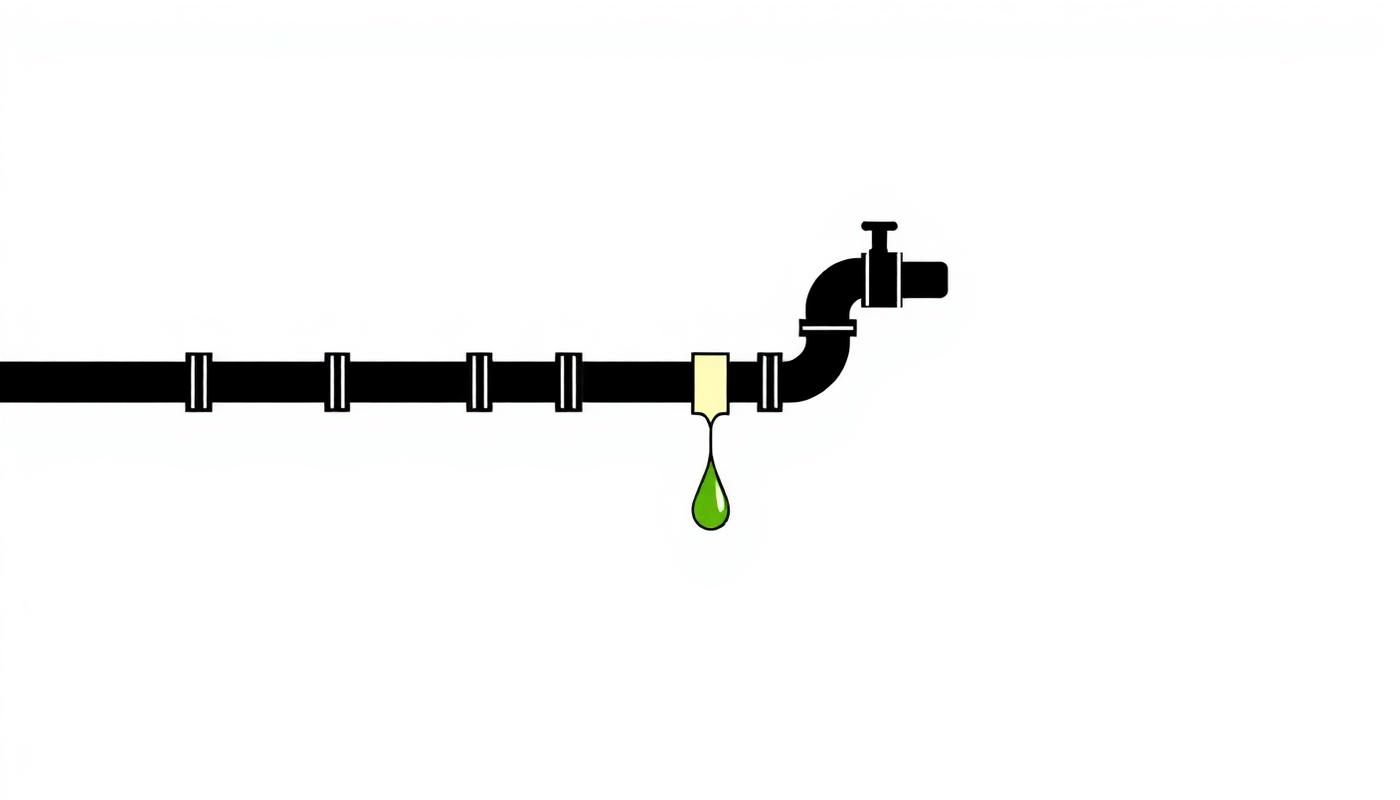
Before you can fix retention, you need to know exactly where revenue is actually leaking — and it isn't always where brands assume. We diagnose every store against five checkpoints.
- Traffic — are the right people even arriving?
- Conversion — of those who arrive, how many complete a first purchase?
- Checkout — is friction causing abandonment at the finish line?
- Retention — of those who convert, how many come back? This is where this playbook lives.
- Revenue — the compounding result, measured honestly against CLV rather than top-line sales.
In our audits, the leak is disproportionately found at the Retention checkpoint — invisible in a standard analytics dashboard, but obvious the moment you calculate CLV and repeat purchase rate by segment. That framework is the same one behind our Revenue Audit service.
The 90-Day Retention Roadmap
Phase 1 — Audit & Foundation (Days 1–30)
- Calculate your baseline: repeat purchase rate, CLV, and retention rate
- Audit every existing email/SMS flow
- Map your customer journey against the five stages above
- Set up or clean up segmentation
- Fix or build the two highest-leverage flows first — welcome and post-purchase
Phase 2 — Build & Launch (Days 31–60)
- Build the remaining core flows: replenishment/win-back, browse abandonment, VIP triggers
- Introduce SMS for the moments it's best suited to
- Launch a lightweight loyalty mechanism if the Phase 1 foundation is solid
- Start a consistent, non-promotional campaign cadence
- Put tracking in place for all seven KPIs, in one dashboard you'll actually check
Phase 3 — Optimise & Scale (Days 61–90)
- Review 30 days of data against your Phase 1 baseline
- A/B test subject lines, send times, and offer structure
- Deepen segmentation using real behaviour data
- Identify and specifically target your at-risk segment
- Set the next 90-day goal based on whichever KPI moved the least
Retention infrastructure compounds — month one will look modest next to month three. The brands that give up in week four are the same ones re-starting this roadmap a year later.
Frequently Asked Questions
Expect small, believable movement by day 30, with the real shift showing up around day 60–90.
No — a brand with 500 customers and a genuinely good post-purchase flow will often out-earn a brand with 50,000 unengaged subscribers.
Start with whatever your platform already has. An imperfect CLV calculated today beats a perfect one you never get around to.
Both work — the trade-off is usually speed. An experienced outside team tends to reach Phase 3 results faster.
The platform matters less than actually using the flows and segmentation in this guide. Klaviyo remains the strongest fit for most growing ecommerce brands.
Build a real post-purchase flow. It touches every customer, it's a one-time build, and it targets the exact moment a customer decides whether there'll be a second order.
Everything above, in a format you can print and work through.
- Retention Audit Checklist — every checklist in this guide, in one printable document.
- KPI Tracker — a fill-in table for all seven KPIs, with baseline, 30, 60 and 90-day columns.
- 90-Day Action Planner — a blank version of the roadmap, built for your own commitments per phase.
Ready to see where your own store stands?
Try the free revenue calculator, see how we've applied this exact framework with real brands, or book a discovery call and we'll run the Revenue Leak Audit™ on your numbers together.